


PART 2 - How Do Affairs Start? When a Friendship Becomes Something More
When people think about an affair, they often imagine a clear moment when someone decides to cheat.
In reality, it doesn't always happen that way.
Some affairs begin with a friendship that gradually becomes more emotionally intimate. There may not be an obvious intention at the beginning. Instead, boundaries can shift slowly until the relationship has become something that is being hidden from a partner. This was an important part of Shirley Glass's work on infidelity. In Not "Just Friends", Glass explored how relationships outside a primary partnership can gradually become emotionally intimate and cross boundaries, particularly when there is secrecy, emotional closeness and increasing dependence on the other person.
This is particularly relevant now because there are so many opportunities to connect with people outside our relationships. Workplaces, social media, messaging, online communities and friendships can all create opportunities for emotional intimacy.
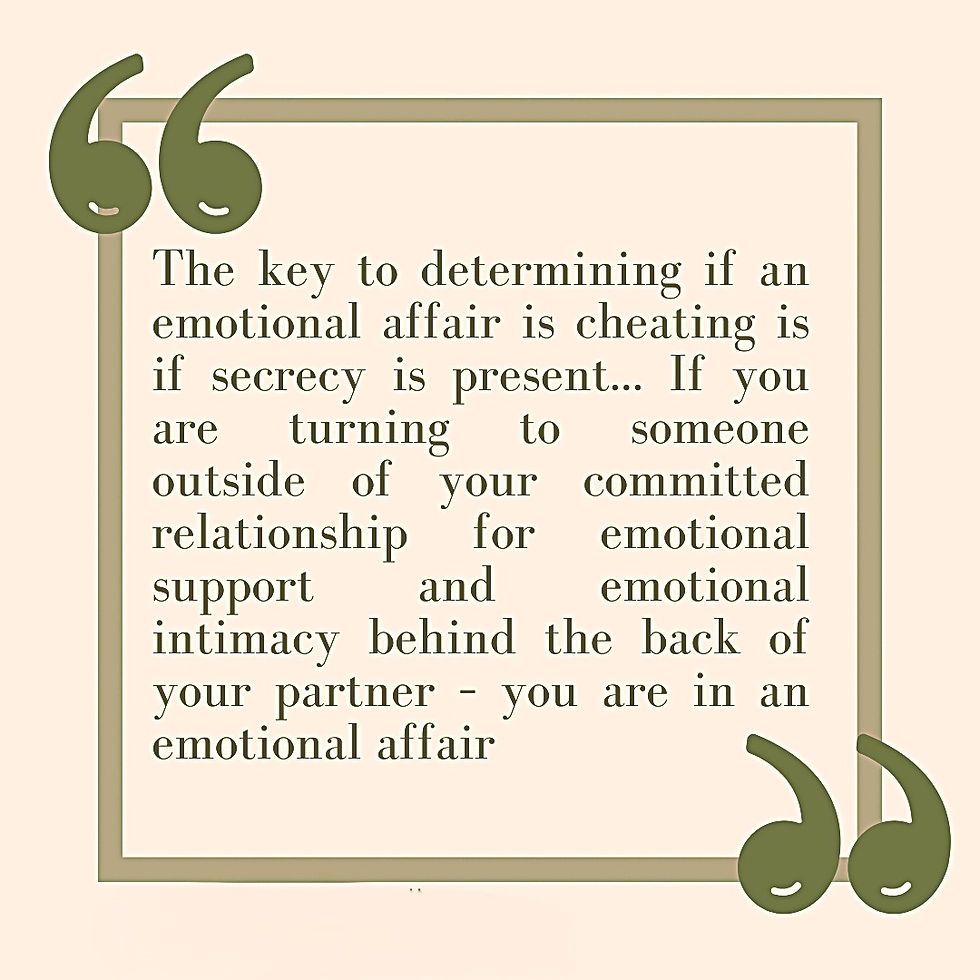
It Can Start Very Innocently
An affair doesn't necessarily begin with someone thinking, "I'm going to have an affair."
It might begin with two people at work who get along particularly well. They start having lunch together and talking about their lives. Perhaps one person is having difficulties at home and begins confiding in the other. They start messaging outside work, the conversations become more personal and the other person becomes someone they look forward to seeing. Eventually, they may start deleting messages or avoiding mentioning the friendship to their partner.
At some point, the relationship has changed, even though the person may still be telling themselves that they're "just friends."
When Does a Friendship Become a Problem?
There isn't one universal point at which a friendship becomes an affair. Couples have different boundaries, and what feels appropriate to one couple may not feel appropriate to another.
However, there are some signs that a friendship may be moving into territory that could threaten the relationship. These can include:
hiding or deleting messages
becoming uncomfortable if your partner sees the conversations
sharing personal or emotional information that you don't share with your partner
turning to the other person for emotional comfort before your partner
deliberately creating opportunities to spend time alone together
feeling excited or emotionally dependent on contact with the other person
minimising how close you have become because you know your partner would be uncomfortable
developing a level of secrecy around the relationship
None of these automatically means an affair is happening. They can, however, be useful warning signs that boundaries may need to be discussed.
Emotional Affairs Can Be Just as Painful
One of the things that can make emotional affairs so difficult for couples is that while there may not have been sex involved, the betrayed partner may still feel profoundly hurt because their partner was sharing something emotionally significant with another person.
Perhaps the other person knew about their partner's worries, hopes and frustrations before they did. Perhaps their partner was turning to the other person when they were upset. Perhaps there were conversations that would never have happened if the partner were sitting beside them.
The pain can come from realising that someone else was being given access to a part of the relationship that the betrayed partner believed belonged within their partnership. This is why saying, "Nothing physical happened," doesn't necessarily make the betrayal feel less significant to the other person.
Secrecy Is Often an Important Part of the Problem
There is a significant difference between privacy and secrecy.
Everyone is entitled to some privacy within a relationship. However, when someone knows that their partner would be uncomfortable with a particular relationship or behaviour and deliberately hides it, the secrecy itself can become part of the betrayal.
For example, imagine someone who messages a colleague regularly. They know their partner would probably be uncomfortable if they saw the messages, so they delete them before going home. Nothing physical may have happened, but the person is already making decisions to protect the relationship with the colleague from their partner's knowledge.
That doesn't automatically mean an affair exists, but it is a boundary worth examining.
Attraction Doesn't Automatically Mean Infidelity
Another important distinction is that being attracted to someone else isn't necessarily the same as being unfaithful.
People in committed relationships can still notice that another person is attractive. What matters is what they choose to do with that attraction. There is a difference between noticing someone is attractive and deliberately feeding the attraction through private conversations, flirting, fantasising, seeking opportunities to be together and creating emotional intimacy. This is where boundaries become important.
A couple may never have discussed what they each consider inappropriate because they have simply assumed they see relationships in the same way. Once an issue arises, they can discover that they had very different expectations.
Why Boundaries Matter in a Relationship
Healthy boundaries aren't about controlling your partner or preventing them from having friendships. They are about understanding what helps protect the relationship and agreeing on expectations together.
For example, couples might need to discuss:
what they each consider flirting
whether private messaging with someone else is okay
how much emotional intimacy with another person feels appropriate
whether discussing relationship problems with another person crosses a boundary
what they are comfortable sharing on social media
how they would handle attraction to someone else
what they would want their partner to tell them if a friendship began becoming emotionally significant
These conversations can feel awkward, but avoiding them doesn't make the issue disappear.
Why Would Someone Keep Going Once They Know It's Becoming Inappropriate?
This is another question that often comes up after an affair.
Sometimes the person may tell themselves that they can control it. They may minimise what is happening or convince themselves that because they haven't had sex, they haven't really crossed a line.
They may also be enjoying something about the relationship that they don't want to give up. The attention may feel good. The person may feel understood, attractive or exciting. The relationship may provide an escape from problems they don't want to face.
This can create a pattern where the person continues moving towards something while simultaneously telling themselves that they aren't really doing anything wrong.
Understanding How It Started Can Help With What Happens Next
Understanding how an affair began isn't about finding an excuse for it. It is about understanding the pathway that led there.
For a couple trying to recover, questions such as these can be important:
When did the relationship with the other person change?
When did secrecy begin?
What boundaries were crossed?
What was happening in the primary relationship at the time?
What was the person getting from the other relationship?
Were there opportunities to stop it earlier?
What would need to change to prevent similar boundary crossings in the future?
These questions can be uncomfortable, but they can also provide information that a couple needs if they are going to rebuild trust.
If You're Trying to Understand What Happened
If you're trying to make sense of an affair in your own relationship, you may not have all the answers yet. You may be trying to understand what happened, what it means for your relationship and what needs to change from here. You may also be carrying a lot of questions that are difficult to work through on your own.
Sometimes having a space to slow things down and look at what has happened can help. This isn't about finding someone to blame or deciding straight away whether you should stay or leave. It can simply be about understanding the relationship, the impact of what has happened and what each of you may need moving forward.
If you and your partner are finding it difficult to have these conversations without them turning into blame, defensiveness or further hurt, couples counselling can provide a safe and supported space to work through them. If you're in Redlands, Brisbane or elsewhere in Australia and would like some support to understand what has happened and what comes next, you're welcome to get in touch with me at Anchoring Your Life Counselling. You don't need to have everything worked out before you reach out. Sometimes the first step is simply having a conversation about where things are at and what support might be helpful.
You may also find these resources helpful:
→ Book a session or enquire today
Flexible scheduling · Online & in-person · Confidential